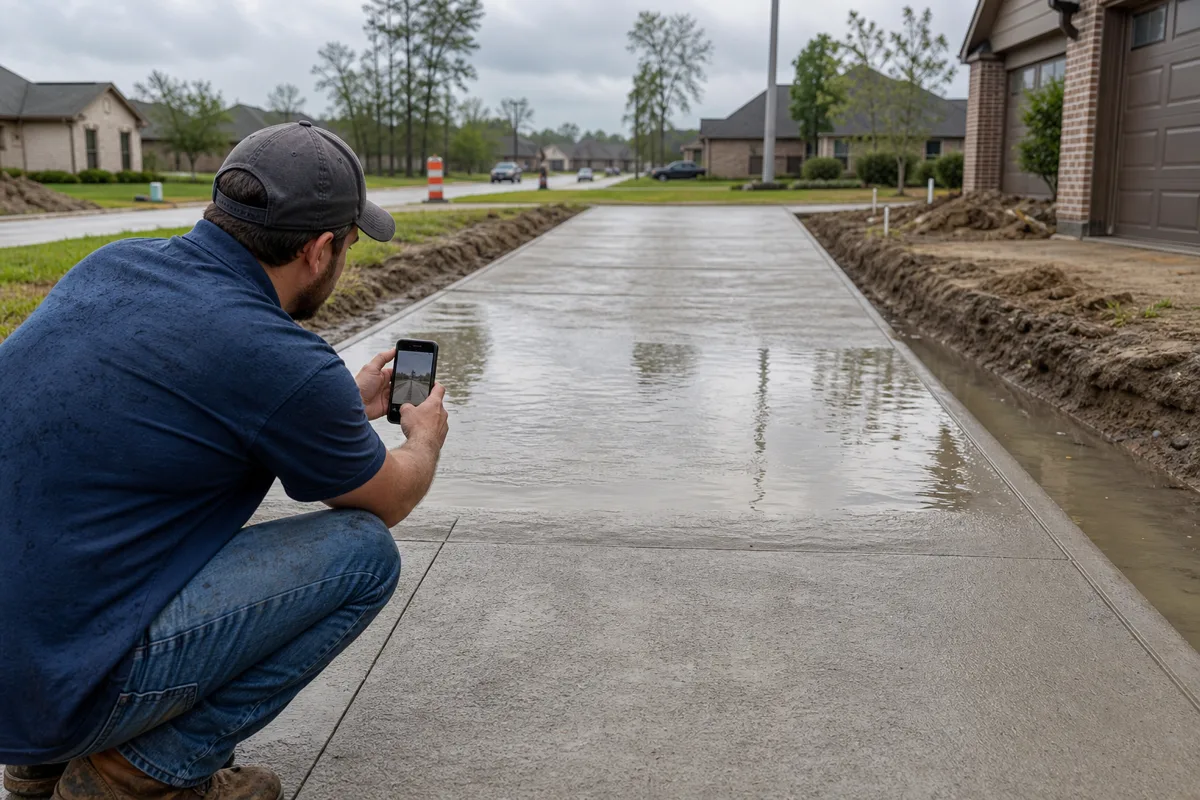
What should Atascocita property owners know about driveway inspection after rain?
- Rain reveals drainage behavior that can be hard to see during dry weather, so photos and notes can make an assessment more useful.
- Document the extent, drainage behavior, and changes before requesting a scope.
- Compare repair or replacement plans by what they address, not by headline price alone.
Rain reveals drainage behavior that can be hard to see during dry weather, so photos and notes can make an assessment more useful. For Atascocita homeowners, the useful question is not simply whether concrete looks worn. It is what the visible condition says about support, water, movement, use, and the limits of a repair. This guide will provide a safe post-rain observation checklist for water paths, ponding, erosion, joints, and garage transitions.
Residential concrete around Atascocita works hard. Driveways carry repeated wheel loads, patios receive roof and yard runoff, and exposed surfaces move through long periods of sun followed by wet weather. Those local conditions make careful observation important, but they do not justify a diagnosis from a photo alone. A useful decision combines what can be seen on the surface with how the slab behaves and what is happening around it.
Quick answer for Atascocita homeowners
Rain reveals drainage behavior that can be hard to see during dry weather, so photos and notes can make an assessment more useful. Look at the full paved area, not only the most obvious mark. Note changes in height, standing water, loose material, damage at edges and joints, and whether the condition is isolated or repeating. Those observations help separate a limited maintenance concern from a repair or replacement discussion.
What to look for before requesting service
| Observation | What to record | Practical response |
|---|---|---|
| Core finding | Photographing puddles before they evaporate. | Photograph and compare over time; request an assessment if the condition is active or creates a safety risk. |
| Decision scope | Checking whether runoff moves toward the garage. | Photograph and compare over time; request an assessment if the condition is active or creates a safety risk. |
| Safety condition | Noting soil loss at slab edges. | Photograph and compare over time; request an assessment if the condition is active or creates a safety risk. |
| Site information | Looking for sediment in cracks and joints. | Photograph and compare over time; request an assessment if the condition is active or creates a safety risk. |
| Assessment threshold | Rechecking the same areas after the pavement dries. | Photograph and compare over time; request an assessment if the condition is active or creates a safety risk. |
Photograph each sign from two distances: one image showing its place in the driveway or patio, and one showing the detail. If water is involved, take a photo while the surface is wet and another after nearby concrete has dried. Do not place hands or tools beneath a shifted slab, and do not enlarge a crack to investigate it.
Why the surrounding area matters
Concrete performance is connected to the ground, edges, joints, drainage paths, and structures around it. A crack close to an eroded shoulder can mean something different from a hairline mark in a stable panel. A low spot near a garage opening deserves different attention from harmless temporary discoloration. Landscaping changes, concentrated roof runoff, vehicle paths, and previous patches all add context.
That is why a responsible assessment considers the whole route from the street to the garage or from the back door to the patio edge. Homeowners can help by describing when the condition appears, whether it changes after rain, and which portions receive the most traffic.
Repair, replacement, and improvement are different scopes
Concrete repair generally focuses on a defined damaged area. Driveway replacement removes and rebuilds a larger section or the full paved route. New construction or patio installation starts with layout, elevations, drainage, and intended use. Decorative stamping or staining changes appearance but does not substitute for correcting unstable or deteriorated concrete.
A smaller scope is not automatically better, and a larger scope is not automatically more durable. The appropriate scope is the one that matches the cause, extent, usable remaining concrete, and goals for the property. Atascocita Driveway Repair lists residential driveway repair, concrete repair, driveway replacement, driveway construction, concrete stamping, concrete staining, patio installation, foundation services, and concrete slab foundation installation on its live site. Review the driveway and concrete services described on the homepage before requesting an estimate.
A practical decision framework
- Map the extent. Count affected panels or areas and mark where the condition begins and ends.
- Check function. Note trip edges, vehicle transitions, drainage, access, and whether loose material is present.
- Look for an active condition. Compare dated photos and observe the area after rain without assuming the cause.
- Define the goal. Decide whether the priority is safety, drainage, reliable access, appearance, or a new outdoor-use area.
- Request a site-specific scope. Ask what will be addressed, what will remain, and how the plan responds to observed conditions.
Questions to discuss during an estimate
Ask the contractor to identify the proposed work boundary and explain why it follows those panels or edges. Discuss how water will move after the work, how the finished surface will meet the garage, street, walk, door, or existing slab, and what access will be unavailable during the project. For replacement or new construction, ask about removal, base preparation, forms, joints, finishing, curing, and cleanup at a level appropriate to the project.
Also ask what is not included. A clear exclusion is useful information, especially when landscaping, drainage components, utilities, or adjacent concrete may affect the work. Avoid relying on a universal schedule or performance promise before the actual site and scope have been evaluated.
How Atascocita conditions influence planning
Local homeowners often need to consider intense sun, warm surfaces, sudden rain, roof runoff, irrigated landscaping, and soils that can change with moisture. These factors can interact with slab support and joints. They should inform observation and planning, but no single climate factor proves why concrete changed.
Keep drainage paths visible and avoid allowing soil or mulch to hide slab edges. If a low area collects water, document its depth and duration without creating a tripping hazard. If the condition is near a tree, utility, foundation, or public sidewalk, flag that relationship during the estimate so the proper scope and coordination can be considered.
What a useful written scope should communicate
A useful scope identifies the work area, describes the intended outcome, and states the main stages. It should help the homeowner understand whether the work is a localized repair, panel replacement, broader driveway replacement, new construction, decorative treatment, patio installation, or foundation-related service. Materials and methods must be selected for the actual project rather than copied from a generic checklist.
The scope should also make communication easier. Confirm who will discuss schedule changes, how access will be managed, and when project-specific care instructions will be provided. If a decision depends on conditions that become visible only after removal, ask how that possibility will be communicated.
Common mistakes to avoid
- Treating every crack or stain as proof of the same underlying problem.
- Covering an active condition for appearance without considering movement or water.
- Ignoring the transition to the garage, street, sidewalk, doors, or neighboring concrete.
- Choosing decorative color or texture before confirming the slab and drainage plan.
- Comparing estimates only by price while the scopes describe different work.
- Driving or placing heavy loads on new concrete before the contractor’s project-specific access time.
Which primary sources support this guidance?
The following primary or standards-based resources explain the underlying safety, soil, material, or installation principles. Local codes and a site-specific assessment control the final scope.
- FHWA concrete repair guidance
- 2010 ADA Standards for Accessible Design
- EPA National Stormwater Calculator
What are the main takeaways about driveway inspection after rain in Atascocita?
Rain reveals drainage behavior that can be hard to see during dry weather, so photos and notes can make an assessment more useful. Document the extent, changes, water behavior, and access needs; then compare a proposed scope with the condition it is meant to address. For help with a concrete or driveway project in Atascocita, review the current service information and use the contact page to request a free estimate. You can also call 281-626-5234.
Frequently Asked Questions
What should an Atascocita homeowner do first about how to inspect your driveway after heavy rain?
Start by documenting the location, extent, and any changes after rain or regular use. Keep the area clear, avoid assuming a cause, and request a site-specific assessment when the condition affects safety, drainage, or several parts of the concrete.
Does Atascocita weather affect driveway inspection after rain?
Heat, sun, moisture, and heavy rain can influence concrete and surrounding soil, but they are rarely the only factors. Support, drainage, joints, use, age, and existing damage should be considered together.
Can one damaged area be addressed without replacing all the concrete?
Sometimes. Localized work is more practical when the cause and damage are confined, neighboring concrete is stable, and the repair boundary can follow a logical joint or panel. Widespread movement or deterioration may call for a broader plan.
How can I prepare for a concrete assessment in Atascocita?
Take wide and close photos, note when you first noticed the issue, record where water collects, list access or vehicle needs, and point out any recent changes. This information helps make the on-site conversation more specific.
Where can I request an estimate from Atascocita Driveway Repair?
You can use the website contact page or call 281-626-5234. Describe the concrete area, the main concern, and any drainage or access conditions you have noticed so the request can be routed appropriately.